

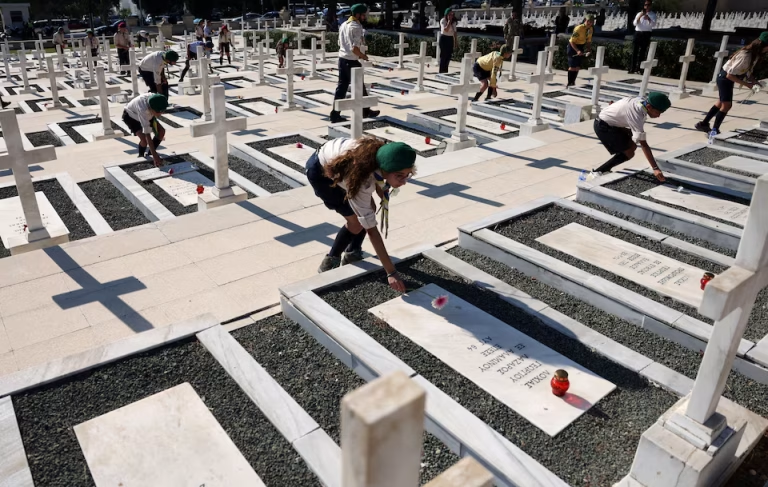
Cyprus marked the 52nd anniversary of Turkey’s 1974 military intervention, as the island’s divided communities looked toward a renewed United Nations initiative aimed at breaking decades of deadlock in reunification talks.
Air raid sirens sounded across the Greek Cypriot-controlled south at the exact time Turkish troops landed on the Mediterranean island in 1974, days after a brief Greek-backed coup. In the Turkish Cypriot north, military commemorations were held in the self-declared state recognised only by Turkey.
The anniversary comes ahead of a planned visit by United Nations Secretary-General Antonio Guterres from July 27 to 29, part of fresh efforts to revive a peace process that has remained largely stalled for years.
“We hope the conditions will be created for the resumption of negotiations,” Cyprus President Nikos Christodoulides said, expressing optimism that diplomatic engagement could help reopen dialogue between the two sides.
Despite repeated international mediation efforts, fundamental disagreements continue to block progress. Greek Cypriots support the reunification of the island under a federal framework, while Turkey and the Turkish Cypriot leadership maintain that any settlement must recognise two sovereign states.
The Cyprus dispute remains one of Europe’s longest-running territorial and political conflicts. It continues to strain relations between NATO allies Greece and Turkey and remains a significant obstacle to Turkey’s long-standing bid to join the European Union.
Cyprus became independent from Britain in 1960, but tensions between its Greek and Turkish Cypriot communities escalated in the years that followed. Turkey launched its military operation in 1974 after a coup backed by Greece sought union with the Greek state.
While Greek Cypriots view the intervention as an invasion that resulted in the island’s partition, Turkey describes it as a “peace operation” undertaken to protect Turkish Cypriots following intercommunal violence.
More than five decades later, the island remains divided, underscoring the challenges facing international efforts to achieve a lasting settlement in a region that sits at the crossroads of Europe, the Middle East and the Eastern Mediterranean.
